
Watching for the Ice Man
Baseball and Blocks of Ice

We didn’t have a sign in our window, but we still watched for the Ice Man.
So many of you related to the peddlers who came to our neighborhood (the Waffle man a hit) and to my uncle the peddler (he went to other neighborhoods) that I decided to relate the story of our ice man.
He was not only our ice man but a neighbor and a raconteur.
“We need ice, Mr. Ice Man.”
Many of our neighbors still had a sign in the window but not us. Our icebox, replaced by a Kelvinator, was now in the cellar; a storage place for tools, Mason jars and odd stuff.
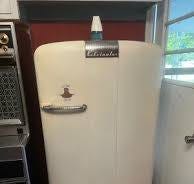
The iceman still patrolled the neighborhood for those who had not yet converted. In the window of those tenements were signs that read “ICE” with the number of pounds needed written in a corner.
Mr. Wallace, best friend Wally’s grandfather, was the man who delivered the ice. He and his wife lived one street over in a bungalow “just big enough for two.”
Of average height, Mr. Wallace had round shoulders and wore professorial wire-rimmed glasses, his eyebrows long and drifting over the tops. Gray hairs sprouted from his ears and nose. His forehead was creased and his short teeth bore a hint of yellow from the tobacco he chewed, a large hunk ever in the side of his cheek.
Even on hot days, when not working, he wore a wool sweater and dark green pants. On workdays, he wore the same dark green pants, now creased, a matching shirt and high-topped boots buffed with an oily sheen. The brim of his green hat sported the stain of hard work.
On his days off he sat with us kids and some attentive adults on the stoop of the three-decker and told stories of old baseball players, he being one himself.
With a shadow of youth lighting his eyes, he smiled and drawled, “Wellll...a…spit, spit...I... ahh ra-memb-a Rabbit Ma-ran-ville, little guy, ya know.” As he spoke, he became infused with a surge of energy. His cheeks glowed, his eyes widened and his voice muffled a chuckle… “Heh, Heh” … as he gazed upward. His breath came in short whooshes. With a spit and splat there came a wad of juice hurdling toward the sidewalk.
“What a play-ya. Once I saw him hit 20 fow-ul balls, ya know, purposely fow-a-ling pitch afta pitch ‘til he’d git the one he wanted. He jes wore the pitcha down.” He paused a long moment and continued. “I ra-memb-a Nap Lajoie, L-A-J-O-I-E is how they spell it, but they say La-Joy-ee, ya know, the kid from Woonsocket, in the Hall a Fame, ya know. Yep... Rabbit, Nap...so many great pla-yas in them days. Let me see that bat.” Spit, splat.
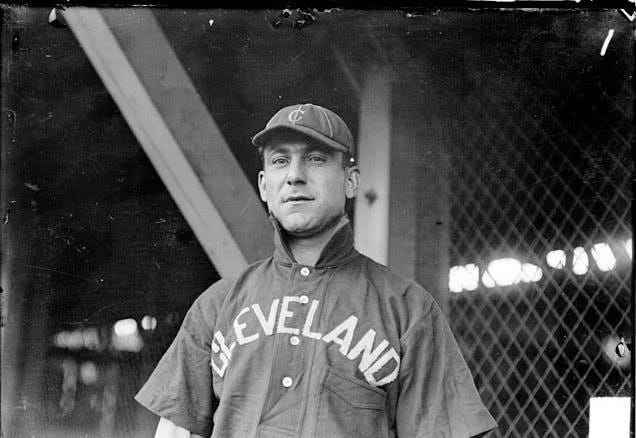
I handed my 32 oz Williams bat. He took it, turned it around, read the label “Louisville Slugga, huh?” and cradled it softly as if he were holding a pigeon. He then tightened his hands around it, not quite white-knuckled but close, and waved it in short horizontal spurts, maybe like the guy Maranville.
We gathered and listened because he deserved respect, but my baseball thoughts were on the Red Sox of the day…Vern Stephens, Dom DiMaggio, Bobby Doerr, Pesky, Goodman and Ted, of course. Never heard of those other guys.
Mr. Wallace was more serious when he worked. His dark green, flatbed truck, smelling of oil and cold and with canvas sides cascading from metal hoops, rumbled up to the six-tenement house and stopped with a hiss.
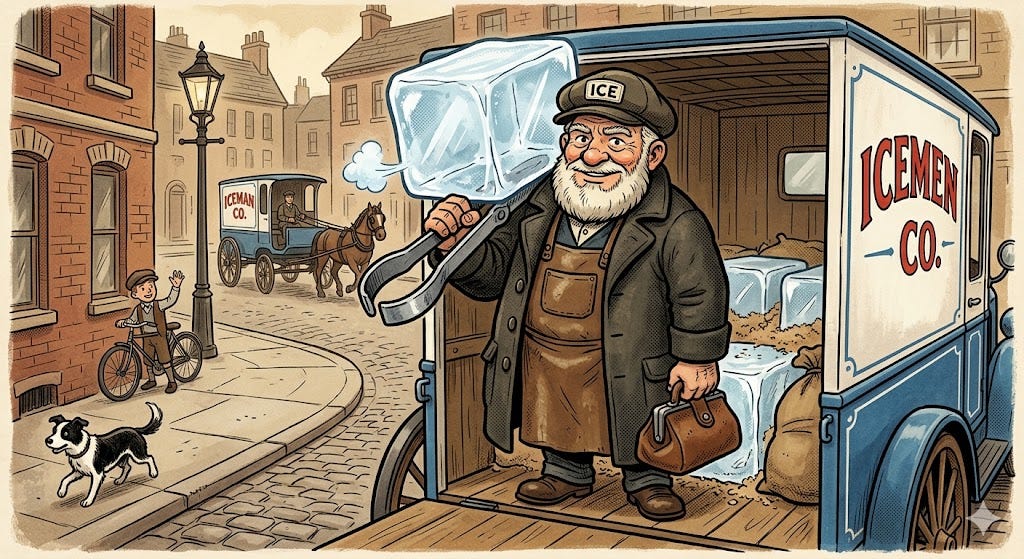
He got out, slammed the door, spun on the thick sole of his boot, walked to the rear, turned his head, looked up and in one window was a sign. “OK, they need twenty pounds,” he mumbled, a chewed cigar dangling from the corner of his mouth. He flipped open the canvas, investigated the deep, dark end of the truck, placed his cigar on the edge of the bed, rubbed his palms on his trousers and pulled on his gloves.
Toward the front of the truck were huge blocks of ice covered with a heavy leather tarpaulin. He slid the tarp, spotted a huge cake that he wanted and with a long handled, hooked stick, nailed the glistening piece and slid it to him.
Looking over the top of his glasses, he surveyed the piece with the skill of a surgeon and, with a tip of his head and a calculated glance, cut a piece from the block using a sharp pick that sent a smooth, piercing shockwave of white peeling apart the layers.
The pick read his mind and followed the line; a phenomenon of nature, I guess, or more likely, Mr. Wallace, the ice diamond-cutter. He leaned back, peered over his glasses and surveyed the result.
“Yup. Good. 20. Jes right.”
He replaced the pick in the hip holster on his belt with the move of a gunslinger. I loved to watch him drive that pick through the ice… carving just the right size with small slivers left over for us. With wide eyes, I asked, “Can I try that, Mr. Wallace?” The pick looked like it might be fun and…easy.
“No, sorry son. Jes a bit too dangj-a-rus.” He flipped me a small piece of ice. It was like those in the milkman’s truck, refreshing on those summer days of shimmering heat and cicadas; but the milkman’s ice was different. His ice just lay there dripping idly while Mr. Wallace’s was dynamic, razor sharp and real.
Mr. Wallace draped a rubber cover over his right shoulder, grabbed the tongs hanging from the truck. He pierced the sides of the block and with a bolt of efficiency, picked up the ice, paused, grunted and swung it onto his right shoulder. Bent toward the ground, with beaded, melting ice water dripping down the rubber cover and hitting first the back of his pants at the calf and then the heel of his leather boot, he methodically climbed the stairs to the door and knocked.
“Who is it?”
“Ice man”
From behind the door, there was a clank of bottles and a barking dog. “Good. Come in.” Mr. Wallace melted into the house.
The house was a behemoth of six tenements each with its own porch. Shaded by huge maples, it was an uninviting, gray ship with a miniature front yard of damp, dark dirt enclosed by a rusted fence and an unhinged creaky gate.
Save for a place for the garbage buckets, there was no rear yard. I delivered papers there, running up the grainy, dimly lit, bare, worn stairs on one side of tenements, dropping the papers at each stop.
Mr. Wallace must have had to maneuver his way through that kitchen with the skill of a racecar driver, collect his money and get on down the stairs.
He had to have seen the puddles of melted ice on the kitchen floor; puddles which meant more business. Smiling, he returned to his truck, hooked the tongs, closed the canvas, took off his gloves, put them in his back pocket, wiped his hands on his pants, grabbed the cigar and replanted it in his mouth, turned to us and said, “See ya, kids.” He stepped up to the cab, sat, pushed in the clutch with his left foot, turned the key, tapped the gas with his right foot and off he went, his engine rumbling, splashes of water tumbling in its wake.
I think often about Mr. Wallace. And ice. And the tenement house.
Our ‘cool’ neighborhood iceman was soon to be out of a job when everyone went to the Kelvinator. I doubt that he was disappointed. He had more time for his Red Sox.
And his stories.
© 2026


Thanks for the comments
A deserving story well told and to think of all those hard-working men that did their work, enjoyed and never complained. Ed well told-I feel I was right there with you and your friends.