
The Incomplete Chart * Beyond the History and Physical
Make the Time to Ask

I consulted on a hospital patient, referred because of a gastrointestinal issue. He was elderly, infirm, and near his journey’s end.
During my evaluation, I recognized a kind, gentle, refined, and understated man of dignity ---- one who understood and accepted his fate. I was in and out of his room every day for a week before his discharge.
Each day, as I entered his room, I asked the usual questions. “How was the night, any pain today, any questions about your test results.” Then, after examining him, I told him what to expect for the day.
That was it, but in retrospect, it was not enough, for me. And I did not realize it soon enough.
Some months later, while having my coffee, I read his obituary. I paused, read it again and closed my eyes, thinking, “My goodness, I never really knew this man. What a gem of a person.”
I defaulted to the standard medical interview, the fast-track routine of history and physical. I did little more to get to know him. He was vulnerable in that bed, eyes cast downward, feet jerking, plucking at the top sheet when he spoke.
Sure, I asked what he did for work, but his simple answer belied his professional and personal accomplishments in board work, philanthropy, special interests.
I knew his medical history, but I did not know him.
According to the paper, he had lived a remarkable life as a business person, a friend, and a collector of fine, near-priceless art that he later donated to a museum. I had enjoyed visiting the very works he donated, yet I never gave a thought to the individual behind them—least of all that he would one day be a patient in such proximity to me.
He was eager to chat despite his illness. I was in too much of a hurry to look beyond his medical issues. How was your night? How are you this morning, etc., etc.?
I should have made the time because I realize now that he would have enriched my life. We both would have felt much better.
I recently read David Brooks’ book, “How to Know a Person: The Art of Seeing Others Deeply and Being Deeply Seen.” I read it twice; my highest recommendation. It’s his guide to a deeper human connection by seeing others through their lenses; and thus to be seen in return. His advice is deep, meaningful and practical.
It’s Bill Gates’ favorite Brooks Book.
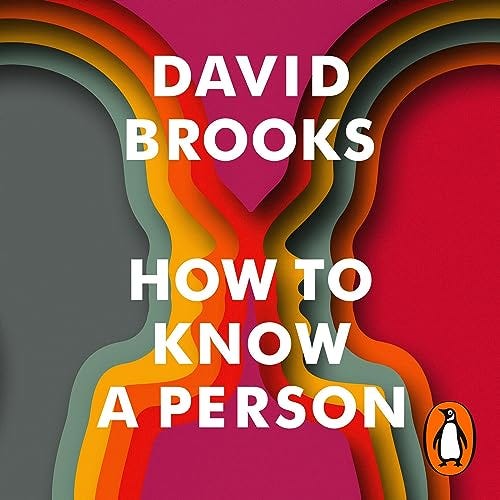
I wonder how someone can assume anything about anyone without first getting to know that person. The best way is to talk.
The next time you open the paper, read the obituary pages closely. Think about the person you knew and wish you had known better.
In her exquisite manifesto for the power of real human communication, Ursula K. Le Guin writes: In most cases of people talking to one another, human communication cannot be reduced to information. The message not only involves, but is also, a relationship between speaker and hearer. The medium in which the message is embedded is immensely complex, infinitely more than a code: it is a language, a function of a society, a culture, in which the language, the speaker, and the hearer are all embedded.
Real communication shouldn’t be one-sided. Show a genuine interest. Ask questions, share a piece of yourself, and resist the urge to curtail the conversation. Take a moment to remind yourself that you are speaking to another human soul—and enjoy the surprise of what you hear.
How about simple questions to start a relationship:
Who is your hero?
If you could live anywhere, where would it be?
What’s your favorite movie?
. . . there are so many others.
Show interest.
© 2026
Well said, as always, Ed. I agree with every word. But in today's world of medicine, where my primary care physician is obviously "on the clock" and his "primary" responsibility seems to be to know which specialist to refer me to, I'm afraid the kind of connection we all value is unlikely to materialize. My father was a "g.p.," a family doctor in the truest sense: his practice included multiple generations of the same family. (Some 90-year-olds still thought of him as "the young doctor." He retired in 1990. Medicine has made some remarkable, even miraculous, progress since then. But, although I wish I didn't have to say it, the healing that comes from personal connection has largely been lost.
Agree completely Dr. I, during my years as a nurse at RIH, I absolutely loved my job, I also loved the team of nurses that I worked with. I was always, or tried very hard to be a hands on bedside nurse. The last five years I worked at RIH, were emotionally draining. Gone was the possibility to show patients that human touch. It had all been replaced by administration that did not get it, so to speak, and computers!! Those terrible computers. I retired after fifty years of nursing. When I have a loved one in the hospital now, I visit, and advocate. Everyone needs an advocate, even if they aren’t on the medical field.