
The High Cost of “Surviving” by Guest Writer, Dr. Yul Ejnes, Retired Primary Care Internal Medicine Specialist
The Human and Economic Impact of Preventable Illness ***

“Most people who are infected survive.” That’s a frequent refrain from the anti-vaccine crowd. It sounds straightforward, but it misses a couple of major points.
The first is that not everyone survives. To dismiss vaccination because “only a few” will die from infections, when vaccination will significantly lower that number, seems heartless. A death that can be prevented should not happen and vaccines clearly reduce the number of deaths. They don’t prevent all deaths – neither do seatbelts – but that doesn’t mean that they don’t work.
The second point is that living through an infection doesn’t mean that one isn’t harmed by the infection. While a lot of the conversation has been about mortality, we should also consider the acute and long-term effects of infection, referred to as morbidity.
As immunization rates decrease due to the actions and inactions of Robert F. Kennedy, Jr.’s Department of Health and Human Services, not only will death rates increase, as we’re already seeing with measles and whooping cough, but the human and economic impact of more people getting sick will rise, affecting all of us.
We already know what viruses can do during winter cold seasons –
missed school days,
crowded doctors’ offices,
overwhelmed emergency departments and hospitals,
work absenteeism due to employee or employees’ children’s illness,
cancelled trips –
but in addition to the flu, RSV, and COVID that accounts for most of these, let’s throw in children with measles, rubella, or mumps, and eventually polio, which we will see if the current trend continues. And let’s make it a year-round problem.
The recent measles outbreak in Texas was costly. A study of school absenteeism by the conservative Hoover Institute reported a 41% increase in absences, which was even higher in pre-kindergarten and kindergarten students (71%). The American Action Forum, a center-right policy institute, looked at the cost of the outbreak resulting from increased use of the medical system, lost productivity from illness, quarantine, caregiving, and the public health response to the outbreak, and estimated a total cost of $35.4 million.
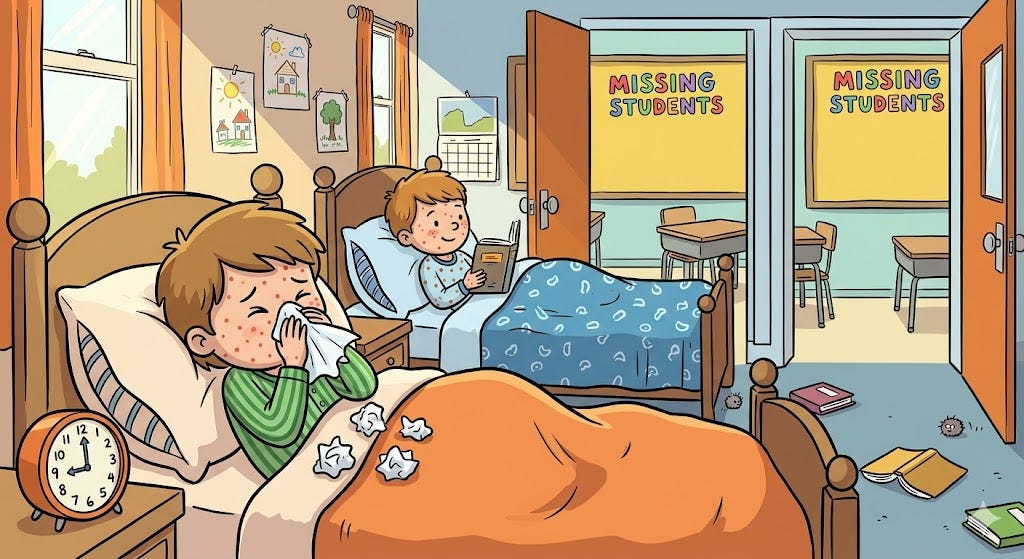
We should not minimize what “surviving” measles, mumps, rubella, polio, RSV, influenza, and COVID-19 mean. It’s more than missing a few days of school or work or having to reschedule a vacation. Recovery is not always complete.
Each of these viruses can cause permanent disability.
For example, measles can cause encephalitis resulting in permanent brain damage, and a brain disease called subacute sclerosing panencephalitis that appears years after the infection and can be fatal. Mumps can cause infertility and deafness.
Polio can cause paralysis. Have you met someone who survived polio but was left with a weakened leg requiring bracing and use of a cane? I’ve taken care of a couple in my career.
COVID-19 can cause heart inflammation (myocarditis), complications from abnormal blood clotting, and what is referred to as “long COVID,” a variety of persistent symptoms after the acute infection.
Rubella can cause a type of arthritis lasting weeks, but more significant are the complications of infection in a pregnant woman, such as deafness, heart defects, and intellectual disability (including autism) in the child.
And no matter how often the social media influencers and ignorant politicians repeat it, zinc capsules, apple cider vinegar, and ivermectin will not fix any of this.
The next line in the anti-vax anthem after “very few die, but most survive” is that “yes, there are complications of infection, but vaccination has an even higher rate of complications.” This has been studied extensively and is untrue.
Emphasis Note: Vaccination does NOT have a higher rate of complications
It’s ironic is that most of the people who are rejecting vaccines for themselves or their children are themselves the beneficiaries of vaccines. If they’re not old enough to remember, their parents and grandparents can tell them how it was before vaccines were available, when all one could do was quarantine and hope for the best.
That vaccines save lives and reduce the morbidity of vaccine-preventable infections is not a theory – over a century of study and implementation prove it. As much as some people may want to debate it, those facts are not debatable.
As physicians, Dr. Ejnes and I have experienced these issues and, trust me, they are REAL
© 2026
Superb piece
An importsnt message that needs to be repeated widely and frequently.