
The Gold Cross Pen
And the career book

Mary wrote to tell me she came across my story of her uncle, Dr. Frank; the one I had written some years ago. And she was pleased.
I was eager to tell her how well I remembered her family’s accomplishments—the legacy of an immigrant Federal Hill pharmacist and his wife, who raised extraordinary children in the early 20th century: two physicians, a lawyer, a Chief Nurse, and her father, an electrical and mechanical engineer.
I encouraged her to write to continue documenting the successes of this family, all products of Italian immigrants to Providence.
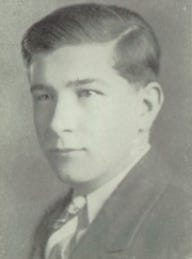
This is my story of her uncle, Dr. Frank Fratantuono, and my career book.
I wrote it in cursive with the Eversharp pen Dad gave me. My penmanship was clear and simple…lines delineated, “T” s crossed one third the way up, “I” s dotted above. Punctuation perfect. Where was this fine hand? It was in and for my junior high school career book.
“If you do not write a career book,” barked Miss Flynn, our guidance counselor, “You WILL NOT graduate. You will REMAIN HERE another year!” Thus, for our last year at George J. West, it became a necessary, albeit final, chore before my next learning stop, Classical High School.
Off to the library I went. My subject, Medical Doctor, was an easy pick because one of my heroes was Dr. Fratantuono, a local practitioner and friend of my father, who saved me from a trip to Boston by making a keen diagnosis. I kinda knew my parents would be pleased if I became a doctor.
Though I did not think it was necessary at the time, I later understood why we had to write a career book. It served as a beacon, a way to learn how to research and to introduce a simple learning experience, now a keepsake. And it helped me reach a plateau, a landmark, in my early life.
Recently, I found the book and was a tad surprised, not because I found it, but because of the memories it provoked. I lifted it gently from the shelf, held it and thought of the days.
The book is housed in a leather-bound binder. The dark red cover has faded. “The cutout adhesive tape letters ‘M D’ were curled at the edges in the center of the cover. I secured them with Scotch tape... a full-blown tape attack.”
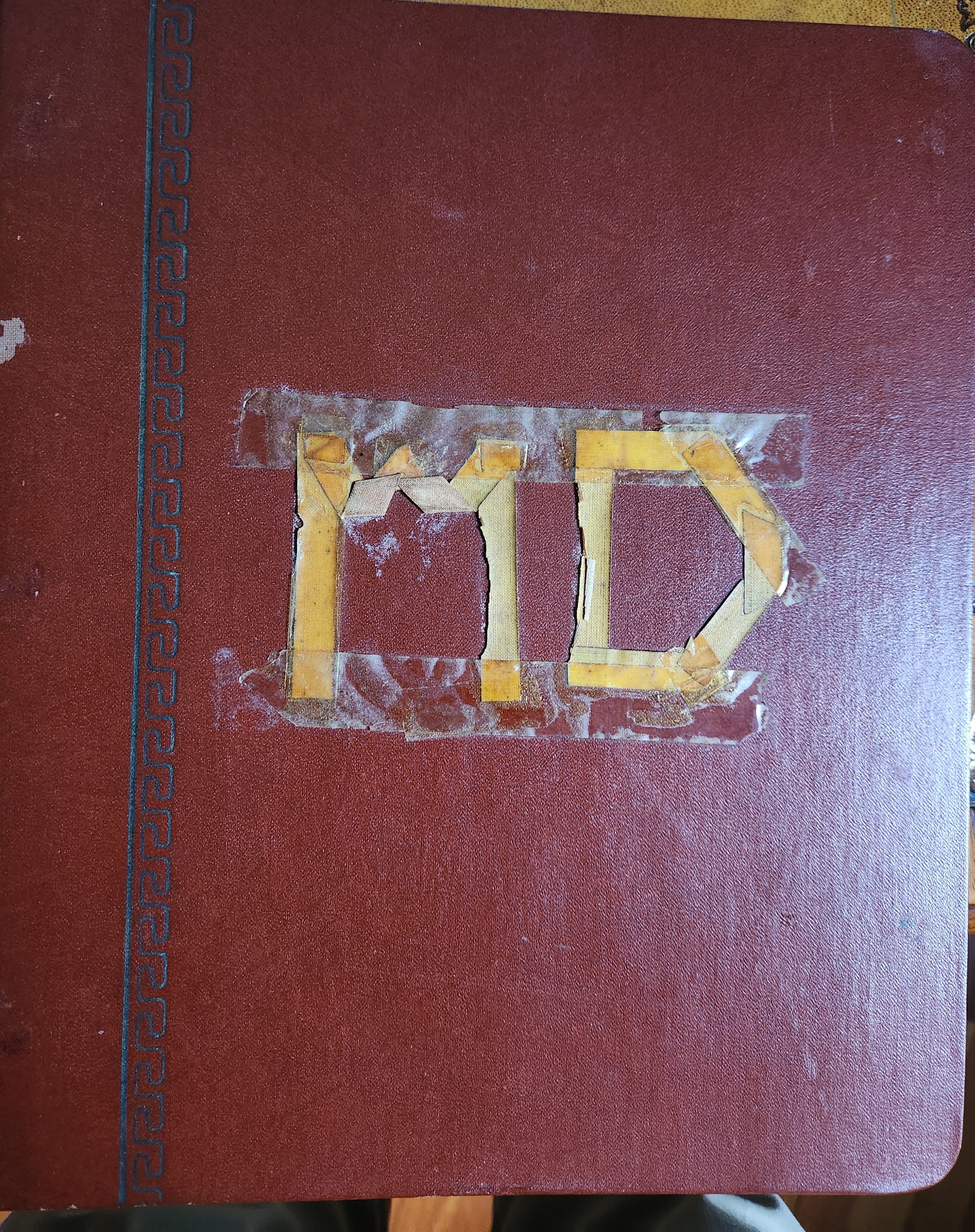
The fragile pages are easy to read. Most have faded to light yellow. The edges are ragged. With caution, I rolled them back one by one. Page one:
Medical Doctor
By
Edward Iannuccilli
Book completed on
May 4, 1954
Nine chapters follow.
Chapter I. History of Medical Doctor (three pages)
Chapter II. Successful Leaders of Medicine…Hippocrates, Galen and Pasteur (four pages).
Chapter III. Importance of Medicine (three more).
Here is what I wrote in Chapter VIII’s Compensation: The gross annual income is under $10,000. Wow!
Moreover, here is what I wrote about Future Trends: …the practice of medicine has been greatly disturbed for fear that present agitation for socialized medicine or for increasing participation by the state in medical practice would result in degradation of the profession.
I wonder where I found that paste, that disorder of words. It certainly was not original, and I suspect I plagiarized it, even though I had references on the back pages. There were no quotation marks or footnotes, however.
Also on the back pages were a few generic pictures… a doctor with a stethoscope, a nurse, a lab test machine, etc. I garnered them from some books a local practitioner gave me. Steve, my dear friend, knew I was looking for pictures, knew I was timid, and, one day, as we walked from school, he said, “C’mon, c’mon. Let’s go into that doctor’s office. Maybe he has some pictures.” It was Dr. Scanlon on Academy Avenue.
“We can’t do that.”
“Sure, we can. I’ll tell him it’s for my career book.” I summoned the courage and in we went. We waited for a short while. The door opened and out stepped the tall doctor.
“Can I help you, boys?”
“Yes,” Steve replied. “My friend Ed is writing a career book about being a doctor, and he is looking for pictures.” Drat. Steve had tricked me with his thoughtfulness.
“Well, come into my office,” he said as he looked around and then sat. “Great idea. Sit. We backed into the chairs in front of his desk. “Here, take these magazines. Cut out whatever you want. I don’t need them anymore.”
“Thank you, thank you, Doctor.” Thanks to Steve, I had my pictures.
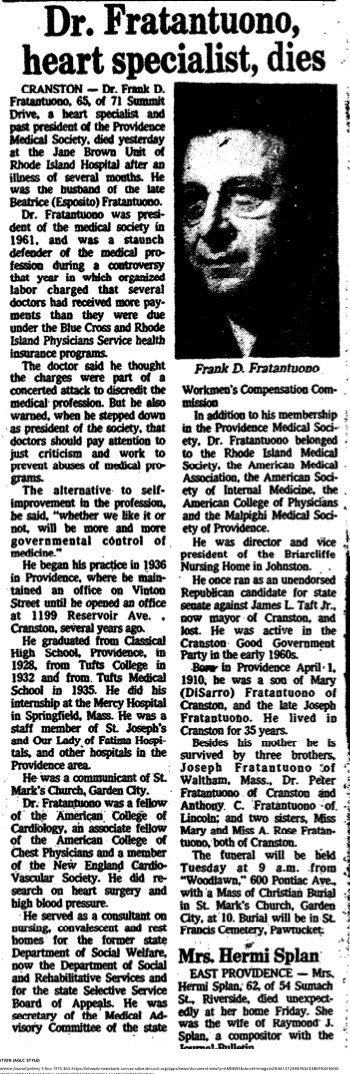
As interesting and as exciting it was to discover and pamper the book, what was even more interesting was the doctor to whom I dedicated it, Frank Fratantuono, and why.
When I was seven, I was a patient at Roger Williams Hospital, and my doctor thought lymphoma was the reason for the large nodes in my neck. He wanted to transfer me to Boston.
Because Dad did not agree, he took me out of the hospital on Friday to the office of another physician, Dr. Frat (as we knew him), who investigated my throat, diagnosed tonsillitis and arranged a tonsillectomy for the following Monday. Thus, the yearbook.
One day late in May 1954, I was called to Mr. Cerilli’s office.
“Whh, Why?” I pleaded with Miss Sherman, our homeroom teacher. “Am I on a list? If so, why?”
“I’m not sure, Edward. The office never said.” The words “the office” sounded like a penitentiary and usually meant trouble. It was the place I avoided for my three years at West.
-----Now?
-----Yes, now.
With dread and the class looking with compassion, I unstuck myself from the chair, left my homeroom, trundled down the three flights of stairs and along the corridor as if molasses were stuck to my soles. Mr. Cerilli, a known taskmaster, never called unless there was trouble.
I knew it. I was dead. OK, what did I do, and how do I tell my father?
I arrived at the closed office door, wondering what lay behind it. A strap? A desk where I would spend the rest of the day under his eye? Miss Flynn, the dreaded guidance counselor? My Dad? That’s it, my Dad. He must have been called.
I peered through the glass pane to see Mr. Cerilli’s assistant calmly typing. She did not appear worried. Didn’t she know I was summoned? I opened the door so very gently. “Come in, come in,” she said with a smile. A smile. Maybe it wasn’t that bad. I went in.
“Have a seat. Are you Edward?” She knew something. I stood by her desk.
“Go ahead, sit.” I went to the hard bench alongside the door, sat, rested my head on my elbow on the arm and waited for an eternity.
She picked up her phone to announce, “Edward is here. OK. OK.” I sat up, rigid.
She looked at me and hummed, “You can go in, Edward.” Dreaded words, kindly spoken.
I opened the door and there, sitting in a maple armchair in front of Mr. Cerilli, who was sitting behind his desk and smiling, was Dr. Fratantuono. My goodness, my doctor! What was going on? Mr. Cerilli stood. “He’s bigger and broader than I realized,” I thought.
Dr. Frat followed. Everyone had a way of taking their time like the teacher, the secretary and now Dr. Frat.
He took so long to get up from the chair, stand, and extend his hand to me. Though I was kinda small, I did not remember him as being so big. Maybe it was the small office. I loved his jolly red face and small smile.
He took a step and offered his hand. I shook it. Tall, stately, he looked over his wireless glasses with squinting eyes and a soft expression and said, “Hi Edward.” He was so nice, so formal. He took his glasses off and polished them. Of course. He was a doctor. In the presence of these two giants, I stood motionless, hands by my side.
“Please sit, Edward.” I inched back into the chair. “The good doctor came in today and asked to see you, so I called for you. The doctor is here to talk to you about your career book.” Mr. Cerilli, though formal, was nice.
“My book?”
“Yes, Edward,” Dr. Frat said. He had the book open to the dedication page where I had written;
This book is dedicated to Dr. Frank Fratantuono, who, through his successful work in this occupation has helped me to try and follow in his footsteps.
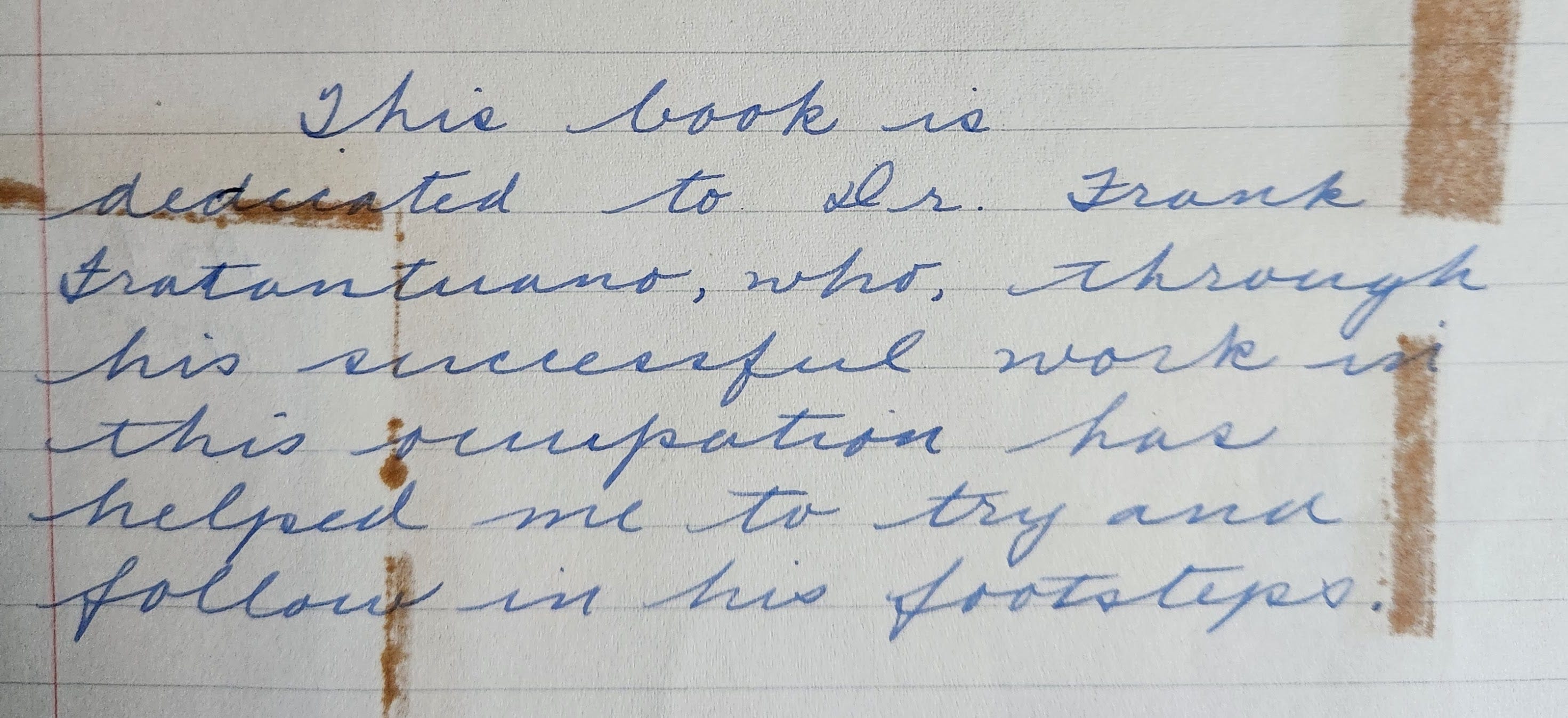
His hand caressed the page. “I am honored that you dedicated the book to me, and even more thrilled that you want to be a doctor.
What prompted this honor?” I told him the lymphoma story. “Well, well. I had forgotten that. Wasn’t your Dad wise to get another opinion?” It gave me pause. Should I have dedicated the book to Dad?
He handed me a small rectangular box wrapped in white paper and tied with a thin blue ribbon. An envelope was taped to it. “You can open the note when you get home, but I’d like you to open the box now if you would.”
I slid off the ribbon, carefully tore the paper and opened the box. It had the word Cross on the cover. It was a gold Cross ballpoint pen engraved with my name; the first among many I was to receive over the years. (I still have it; another story). I was speechless.
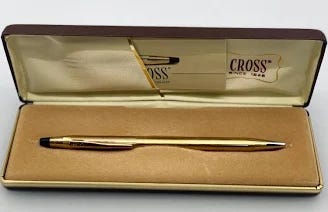
“Uhhh, thank you, Dr. Frat. Thank you.” I looked at Mr. Cerilli. “Is it OK to go now?”
-----Yes, sure, Edward, sure, good job. They both shook my hand.
-----Thank you.
“No, thank you, Edward.” Dr. Frat rested his hand on my shoulder.
I hurried home at day’s end. “Look at this, Dad, Mom. Dr. Frat came to the school with it. I met him in Mr. Cerilli’s office. I showed them the pen. I opened the card slowly, took out the note and read what he wrote in tall letters slanted to the right as if blown by the wind.
Edward,
It was indeed a thrill to read your career book, and it was a great honor to have you dedicate it to me. This is an example of a truly great reward and makes material gains fade into darkness. I trust that God will give me the strength, and that He gives you the guidance to fulfill your ambition. Thank you.
F.D. Fratantuono, M.D.
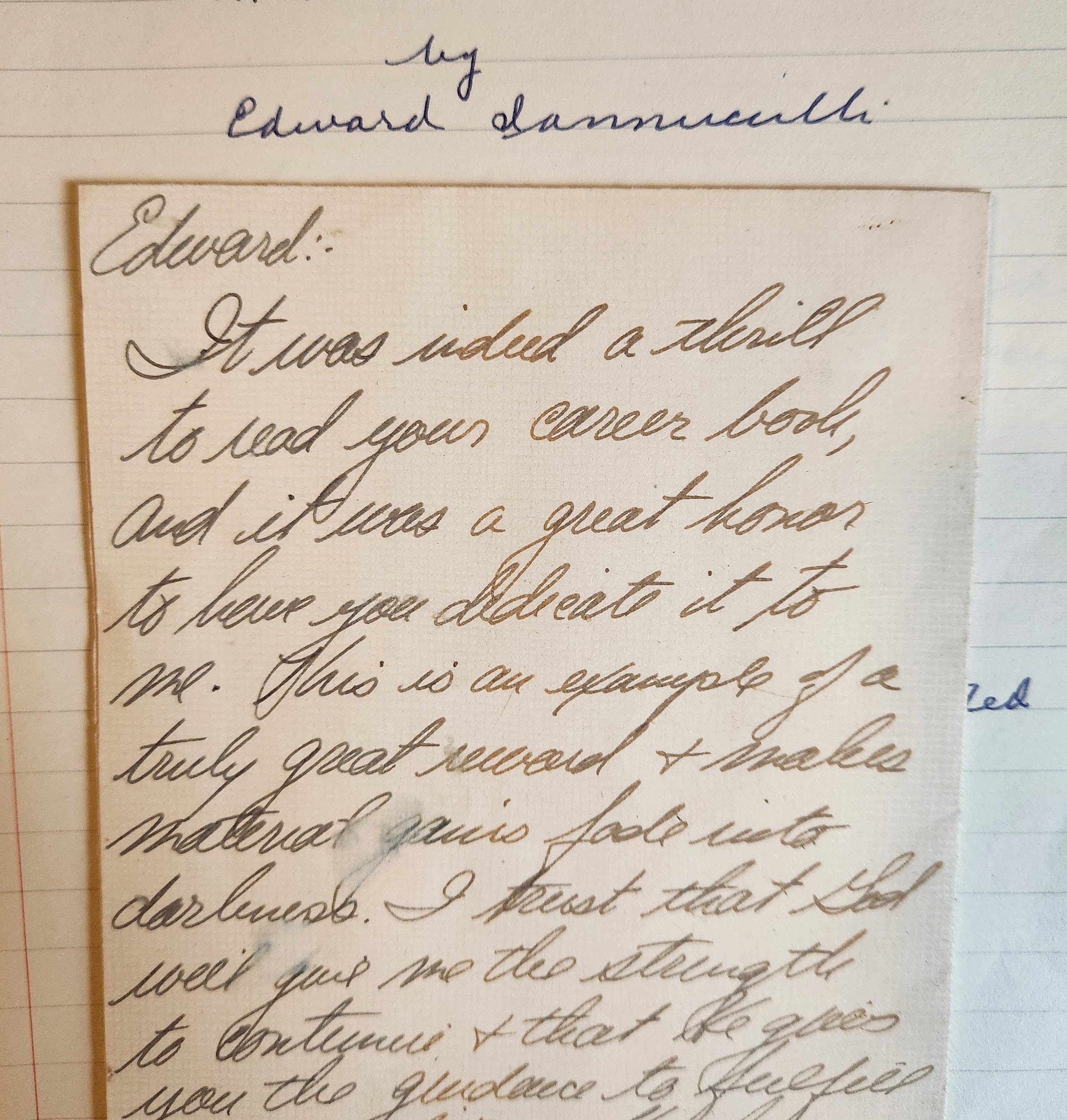
7/1/54
“Oh, Edward, that’s wonderful,” effused Mom.
“Good job, Ed,” Dad called me Ed when he was pleased. The buttons near exploded off his shirt.
There is a trove of things one may keep from years past. I have kept a lot, though I wonder what it should remain and for how long. What will my children do with the stuff when I am gone? Will those things so personal fade along with me into darkness? Who will care that I have a career book, a pen, and a note? What is important to us? What do we leave for the next generation, knowing the physical items we accumulate can be discarded?
I may not have a complete answer, but I am overjoyed that I kept this career book. It captured a dream fulfilled—a true turning point that reminds me of those who gave me the strength and direction to pursue medicine.
In junior high school, I decided who I wanted to become. And with a little guidance, I did.
P.S. Some years later, Dr. Frat became my patient. He passed with dignity.
© 2026