

Our Classical High School Class of 1957 held a luncheon last week—another wonderful opportunity to honor our lifelong friendships and our love for the old school.

I got out my old yearbook to reminisce. I spotted one of my favorite instructors, Miss MacDonald, my English teacher. And that got me thinking of a story.
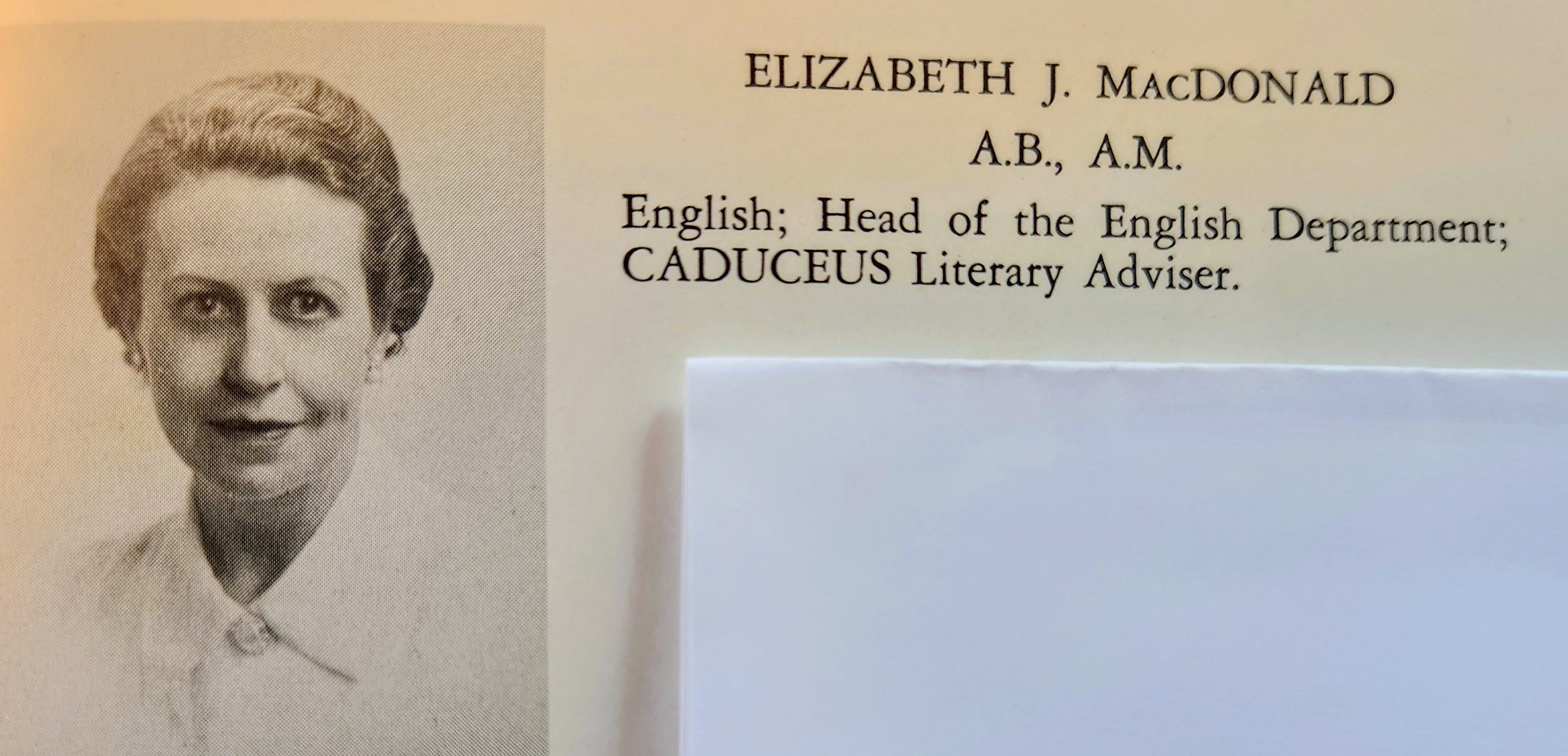
Over the years, I’ve come to appreciate that a good sentence, no matter how long, is one the reader can follow from beginning to end without becoming confused by poor grammar. When I write, I am constantly mindful of proper grammar, a discipline instilled in me by Miss MacDonald.
Recently, while trying to figure out where to place a comma, I reread the book Eats, Shoots & Leaves by Lynne Truss. The book has sold over a million copies since its release in 2003. No, I did not forget commas in the title. That IS the title.
In school, we were taught the strict rules of grammar. Much has changed over the years, and there isn’t enough room here to cover all the once-sacrosanct rules that are now routinely broken or accepted.
For example, nowadays it is considered acceptable to split an infinitive, join two independent clauses with a semicolon, or end a sentence with a preposition. Gad!
In Miss MacDonald’s English class, we might have been hanged for doing any of the above.
Now to my story. Miss MacDonald was a stickler for correct grammar in the spoken and written word. I shuddered when she made us present, particularly in debates.
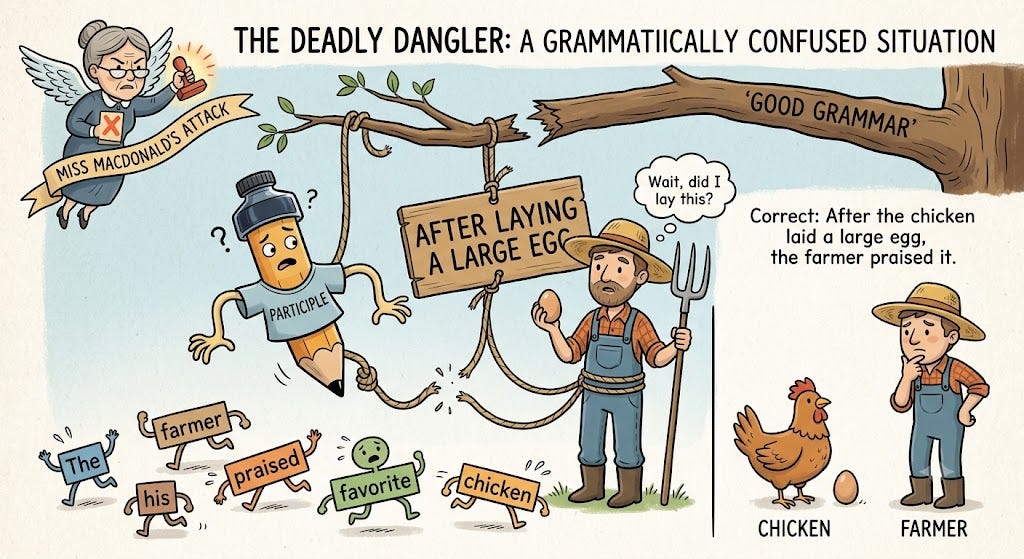
I learned that it was anathema to use a dangling participle. She barked, “If you use one dangling participle in a story, it’s an automatic “D.” If you use two, that’s an “F.”
For example, here is a deadly dangler that would have fired up her wrath: “After laying a large egg, the farmer praised his favorite chicken.” It should have been, “After laying a large egg, the chicken was praised as the farmer’s favorite.” The farmer did not lay the egg.
For one assignment at Classical, I wrote a story which I titled, “The Tragedy.”
She was a giant eyeball on my paper.
Miss MacDonald stood in front of the class to hand out the corrected papers. She got to mine. I waited with anticipation for a great comment since I thought the story was so good.
“Iannuccilli wrote this story titled, The Tragedy, and a tragedy it is. It has two, two, mind you, dangling participles. I never read it once I spotted them. “F” Iannuccilli. Here’s the paper.”
My face flushed with heat and panic.
Do you think I have ever written a dangling participle since?
Grammar is the necessary bane of not just the writer, but everyone.
That she unlocked that level of creativity and discipline within us is a gift that continues to unfold. I am grateful for her high expectations and the exacting standards she held us to in our assignments.
Miss MacDonald is a legend in the hearts of her many students; in the words they wrote and in the outcomes of flat–out learning English.
Don’t dangle your participles.
© 2026