
Repurposing the Behemoth: Lessons from My Father’s Emerson
How a mid-century radio became a symbol of survival and family legacy.

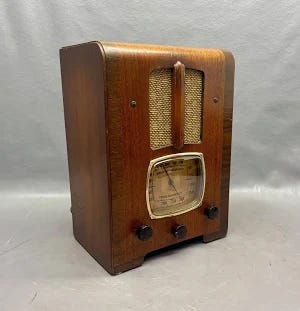
I stood on the cold kitchen floor, peering in at Dad, prone on a rug, asleep in front of the old Emerson Radio in our family room. The upright behemoth with its gumwood cabinet had big, fancy dials and a speaker as tall as I was.
The console was furniture that fit neatly into the corner of the room, displacing everything around it.
The Emerson took some time to warm up after Dad turned it on, but once it did . . . “Boom.”
The sun’s light filtered through the glazed windows, and the yellow hues of the candle chandelier drifted onto his sleeping frame. Against a wall was a faux fireplace, and on it were some artificial flowers from the Calart Artificial Flower Company.
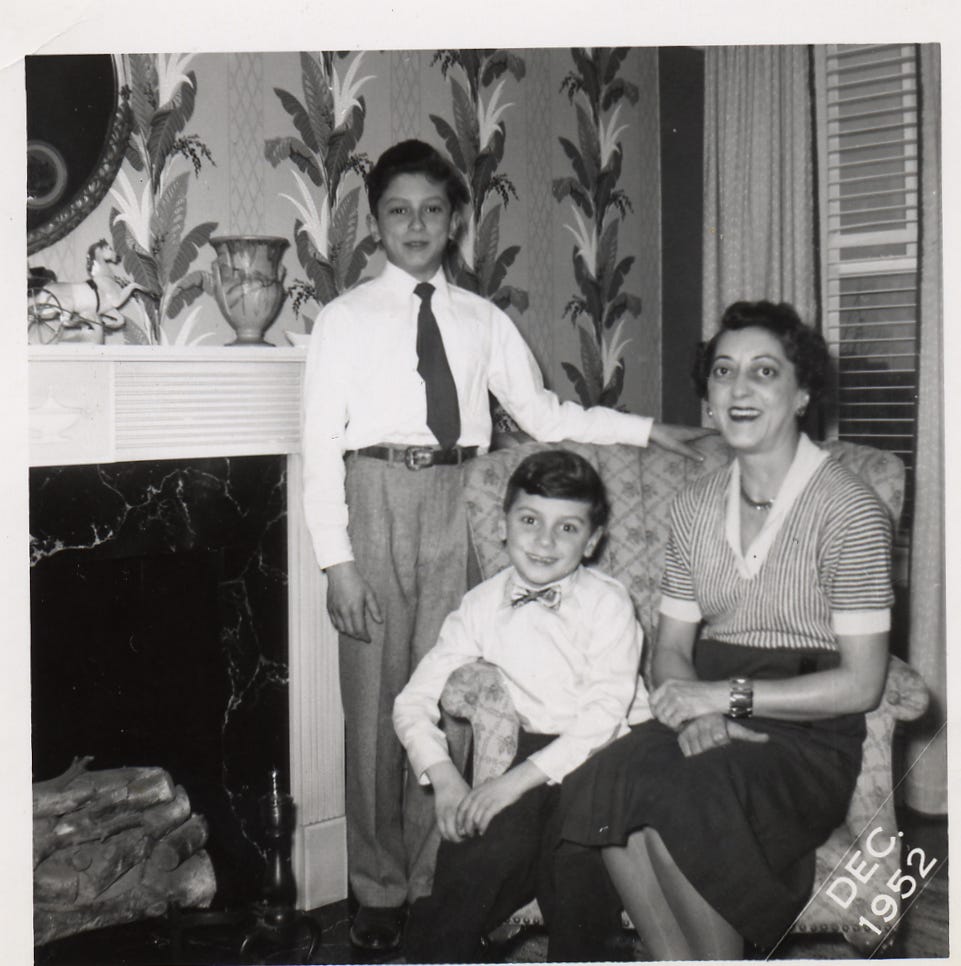
Tucked in a corner was his desk, the one with the swing-down top, the one with not enough books. The few that I remember were: Gone with the Wind, the Funk and Wagnalls Encyclopedia, How to Win Friends and Influence People, and some books on how to fix radios.
On the right side lay his Eversharp fountain pen that he gifted me when I entered junior high school.
There was his work area in a room off to the right, where Dad fixed radios in his spare time; another job to support his family.
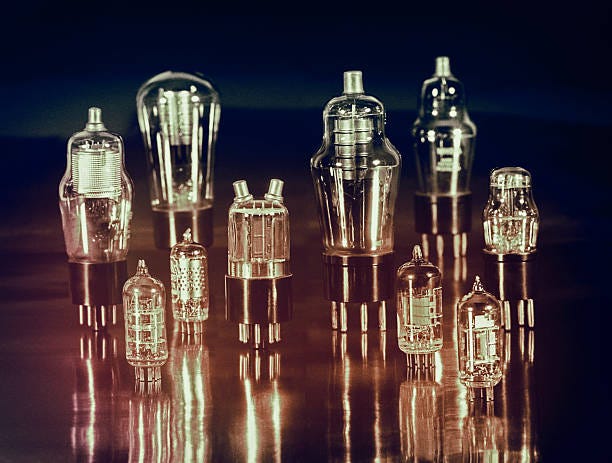
I often stood in that room to peer at his workbench lit by the glare of a fluorescent light. On the bench were radios, some repaired, some expectant. Along the shelf was a row of replacement tubes. The fluorescent glow hit those tubes and lit them like dancing fireflies.
I never touched anything on that desk, a long piece of plywood resting on two horses.
The radios were off limits by my design. Dad never said not to touch anything. I simply did not.
I knew he worked late into the night over those radios. I knew he had to rise early for his twenty-seven-mile trip to Quonset Point.
My son once said to me, “Thanks for teaching us how to work hard to be successful, Dad.”
I gave it little thought until I remembered Dad sleeping on the floor, ear to his behemoth, exhausted by his own schedule. His example taught me, and it carried over to my children. Thankfully.
It’s what grandparents and parents did: work.
It’s what gave us our opportunities.
I expected Dad to say, “When I was a boy, I had none of this; no pen, no radio, no books, little schooling, just work,” but he never did. He never did. He never complained. He never complained of those days in a cold tenement flat with no mother and five siblings.
Were there secrets in that radio and his reason for tucking so closely, or were his Red Sox losing again? Did soporific fumes drift through the cloth covering the speakers?
Maybe resting in front of the radio was his symbol of survival; the place where he found solace, where he disappeared from the stress of raising a family, where the groaning bass cleared his head. And where he remembered how fortunate he was.
Whatever became of that radio? Well, guess what.
Dad, in a fit of creative woodworking, ripped the guts from the behemoth and transformed it into a liquor cabinet. How ironic, because Dad and Mom never drank.
Where was Dad’s center?
Was it lying in front of the radio, meditating?
Since it didn’t need repair, is that why he destroyed it?
Or had he fulfilled his goals, and he no longer needed Emerson’s comfort?
Maybe
Dad and his Emerson were repurposed.
© 2026
Well repairing radios was a very good skill to have. A couple of generations back it was pianos and in your Dad’s generation classic upright radios with good speakers. I do remember the Emerson’s but not as much as the Phillcos which had TV players also! I loved listening to the latest updated radio dramas like the Green Hornet and Dick Tracey on Sunday nights. I had the special Dick Tracey ring which was obtained only at the bottom of certain boxes of cereal back then!
Another wonderful story well told. My dad didn't repair radios, he sold them...along with bedroom sets, living room sets and dining room sets. He owned a furniture store. I remember hearing my dad or other salesmen tell customers that the big radios were not an entertainment center, but a crafted piece of furniture you would be proud to have in your home. I don't think there's a kid who didn't stare at the exposed tubes and electrical chords behind the front console. Those old radios brought the world into your personal space. Occasionally, I could find far off places (Chicago, Oklahoma City, and the 50,000 watt station in Del Rio, Texas), if I patiently turned the dial and the room was silent. Those were magical days.